

Every PE teacher knows the moment. You’ve finally worked up the nerve to ask for new equipment, you send the request, and it comes back with a single question that stops you cold:
“Why do you need this?”
If your answer is “because our stuff is old” or “because we’re running low,” you’ve already lost. Not because the need isn’t real, it almost always is, but because “old” and “low” aren’t reasons an administrator can defend to their boss. Budgets get approved when a request is specific, justified, and tied to something bigger than one teacher’s preference.
The good news: building that kind of request isn’t hard once you know the structure. This guide walks you through exactly how to justify a PE equipment budget so it gets approved, and includes a free template you can fill in and send.
Why most PE equipment requests get denied
Before the how, it helps to understand the why. Most requests fail for one of four reasons:
- They’re vague. “We need new equipment” gives the approver nothing to evaluate or defend.
- They’re not prioritized. A long, flat list of everything you want reads like a wish list, not a plan.
- They’re not tied to student outcomes. Administrators fund things that help kids, not things that are merely worn out.
- They have no external backing. A request grounded only in personal opinion is easy to say no to. A request grounded in standards and safety is not.
The fix for all four is the same: stop asking for equipment, and start making a case.
The 5-part structure of a request that gets approved
A strong PE equipment request answers the questions an administrator is going to ask before they ask them. Here’s the structure.
1. Lead with the student impact, not the equipment

Open with why this matters for kids, because that’s what your administrator ultimately has to justify. The research is clear: the more equipment students have access to, the more active practice time they get, and active practice is where skills, fitness, and confidence are built. When students share one ball among six, most of them are standing around. When a program is properly equipped, every student is moving.
Frame your request around that outcome first. You’re not asking for basketballs; you’re asking for the activity time those basketballs make possible.
Example: “Our current equipment levels mean students spend significant class time waiting rather than practicing. This request is intended to increase active participation time and ensure every student has the opportunity to develop fundamental skills.”
2. Show where you are now (the honest inventory)
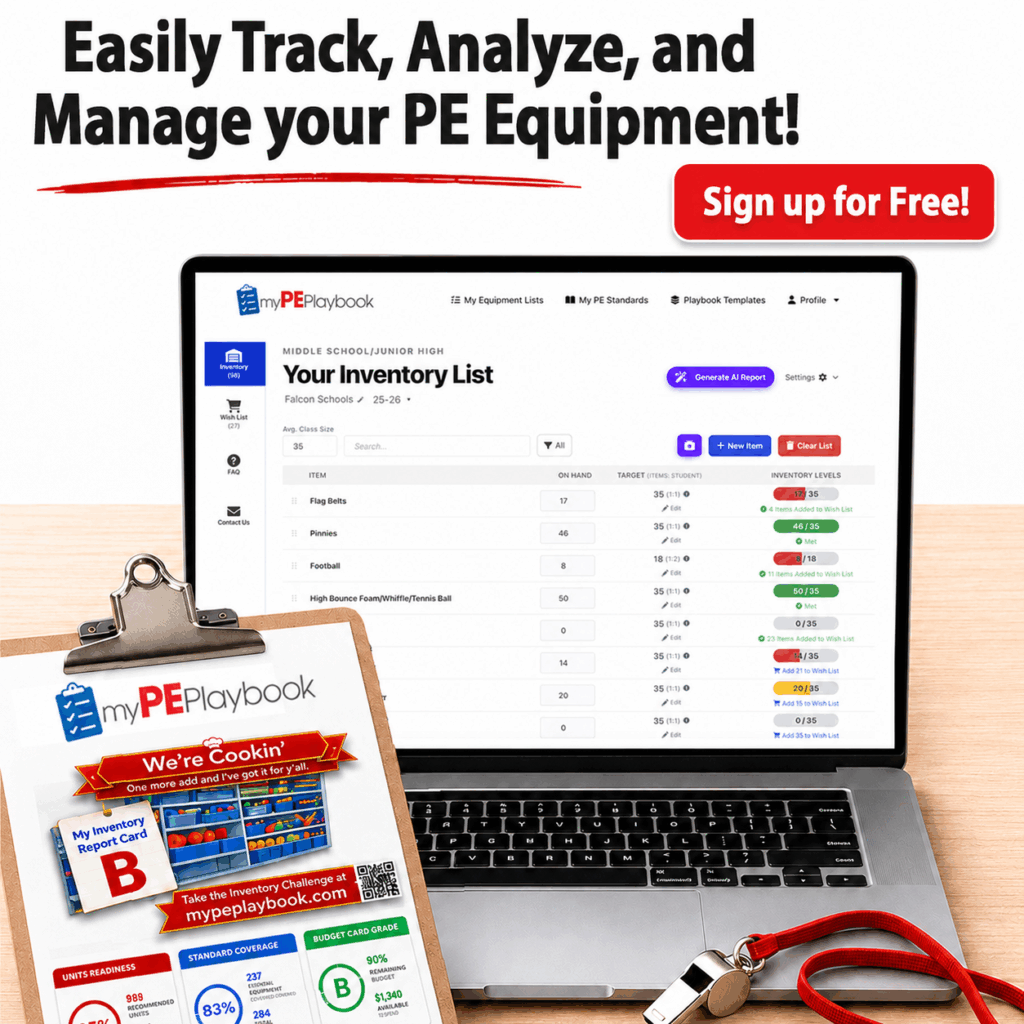
You can’t justify a need you can’t measure. Document what you currently have, how much of it, and what condition it’s in. This is where My PE Playbook can help you. Be honest, including about the things that are fine. A request that acknowledges what you don’t need is far more credible than one that asks for everything.
This is the step most teachers skip, and it’s the one that turns a hunch into evidence.
3. Compare it to a recognized standard
This is the single most powerful move you can make, and it’s what separates a request that gets approved from one that gets “we’ll see next year.”
Don’t anchor your request to your opinion. Anchor it to an authority. Use your district, state or national PE standards and describe what equipment is needed for a quality program to deliver effective instruction. When your request says “standards guidance indicates a program of our size should have X, and we currently have Y,” you’ve removed yourself from the argument. You’re no longer asking for a favor; you’re pointing out a gap against a recognized benchmark.
Administrators can argue with a teacher’s preference. They can’t easily argue with the standards.
4. Prioritize ruthlessly
Don’t hand over a flat list of twenty items. Group your request into tiers:
- Essential / safety: Items where the gap creates a safety risk or makes core instruction impossible (worn mats, too few of a basic item to run a class).
- High impact: Items that would most increase active participation and skill development.
- Nice to have: Everything else.
Prioritizing does two things. It shows you’re a responsible steward of limited dollars, which builds trust for next time. And it gives your administrator an easy partial yes, if they can’t fund everything, they can fund Tier 1, and you’ve still made progress.
5. Attach the numbers
End with specifics: exact items, quantities, and costs, ideally with SKUs or product links so the approver doesn’t have to do any work. A request they can act on immediately is a request that gets acted on. Vague asks create back-and-forth; itemized asks get signed.
The hard part: knowing your numbers
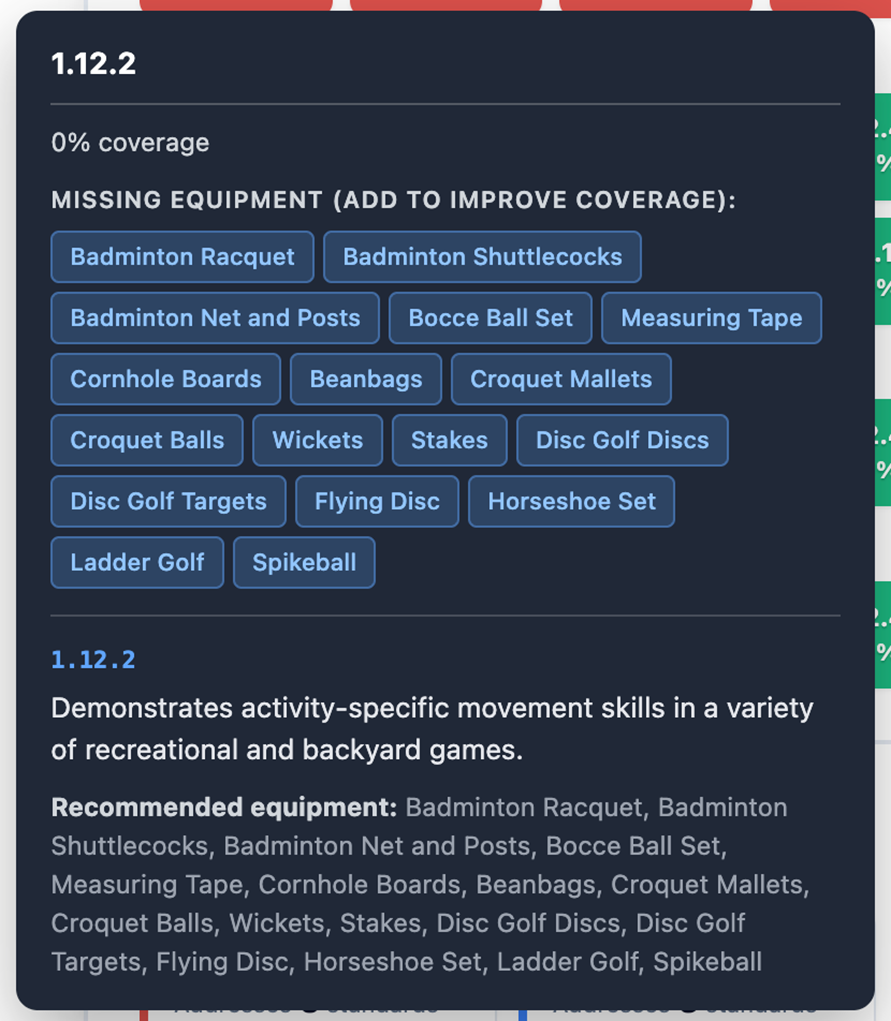
This process works only if you can fill in the two most important sections, where you stand now, and where you fall short against the standards. And that’s exactly the part most teachers don’t have time to figure out, because measuring your program against standards, item by item, by grade and class size, is genuinely tedious to do by hand.
My PE Playbook is a free tool that does it for you.
You enter what’s in your equipment closet. My PE Playbook checks it against your PE standards and shows you exactly where you’re short, organized by priority. The result is a benchmark report that hands you the two hardest sections of this template, already filled in: your current state, and your gaps against the standards. You walk into the budget conversation with proof, not a hunch.
It’s free for teachers, it’s honest (if you’re well-equipped in an area, it says so), and it turns the most time-consuming part of a budget request into something you can finish in a single planning period.
Make your case before budget season
The best time to build your request is before anyone asks for one. Know your numbers early, anchor them to the standards, prioritize what matters most, and put it all in front of your administrator in a form they can approve on the spot.
Most PE teachers walk into budget conversations with a feeling. This year, walk in with a case.