

“You wouldn’t teach math with one pencil. Why do you expect us to teach PE with one ball?”
Most physical educators feel that quote in their bones. You know your program is stretched thin. You’ve patched a unit together with cones held over from three years ago and a ball bin that’s seen better days. But here’s the harder question: could you actually prove it?
When budget season arrives and an administrator asks, “Why do you need this?”, a feeling isn’t an answer. A number is. And right now, most PE teachers have no straightforward way to turn “we’re short” into the kind of specific, standards-backed case that gets a purchase approved.
That’s the gap we set out to close.
Why “enough equipment” is so hard to pin down
Every PE teacher knows the goal: maximum activity time, minimal standing around. The research is clear that the more equipment students have access to, the more active practice they get and active practice is where skill development actually happens.
But translating that principle into “how many basketballs, jump ropes, and mats does my program actually need?” is surprisingly difficult. The answer depends on your grade levels, your class sizes, and the activities you teach. It’s the kind of calculation that’s easy to put off and so it gets put off, year after year, until equipment quietly falls below what a quality program requires and no one notices until something breaks.
Meanwhile, SHAPE America’s National Physical Education Standards and its guidelines for facilities and equipment lay out what a high-quality program looks like. The information exists. It’s just never been easy for a busy teacher to line their own gym up against it.
Three questions every PE program should be able to answer
Before any budget conversation, a strong program can answer three things clearly:
- What equipment do we actually have? Not a rough guess… an accurate, current count, including condition.
- Where are we below standard? Measured against recognized guidance for your grade levels and class sizes, not just a hunch.
- What should we request first? A prioritized list, so limited dollars go to the gaps that matter most.
If you can answer all three, you walk into your administrator’s office with proof instead of a wish list. If you can’t, you’re negotiating from a feeling and feelings rarely win budget battles.
Introducing My PE Playbook
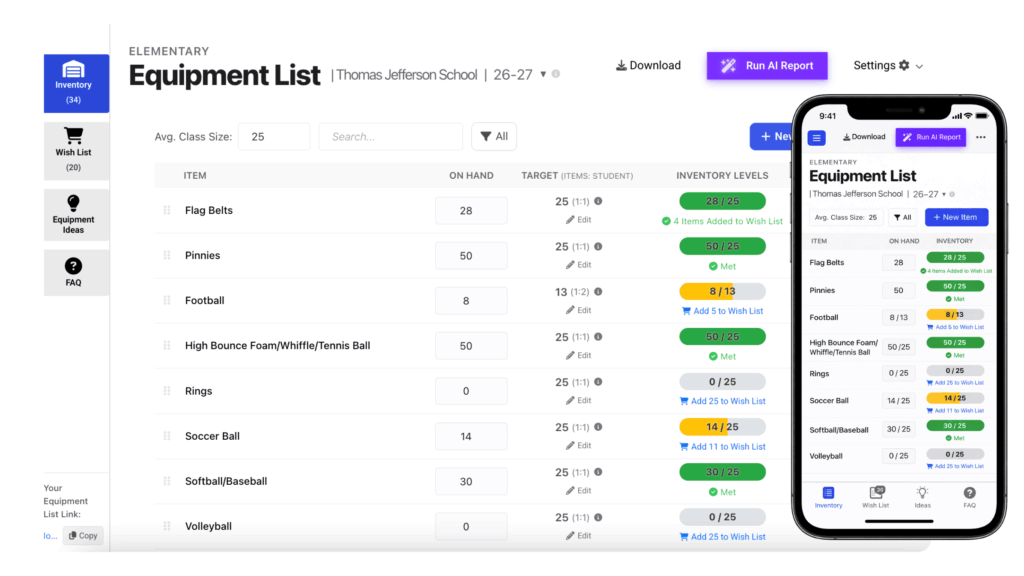
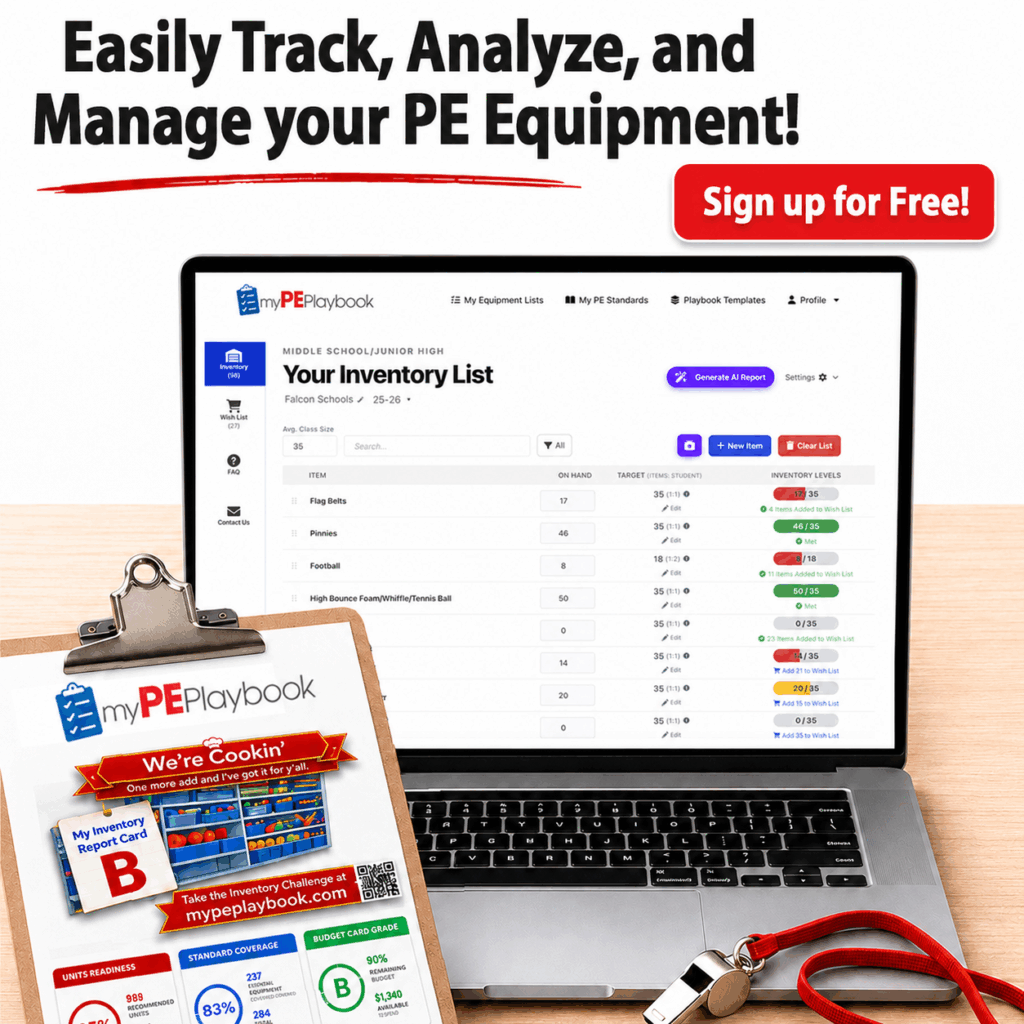
My PE Playbook is a free tool built to answer those three questions in minutes.
Here’s how it works. You tell it what’s in your gym: what you have, how much, and what condition it’s in. It checks your inventory against national PE standards. And it shows you exactly where your program is short, organized clearly enough that you can act on it right away.
The result is a benchmark report: a clean, organized picture of your program’s gaps and the equipment your students actually need. It’s the kind of document you can take straight to an administrator, an athletic director, or a PTA turning “I think we need more” into “here’s where we stand against the standards, and here’s the plan to fix it.”
A few things worth knowing:
- It’s free for teachers. There’s no cost to assess your program.
- It’s honest. If your program is well-equipped in an area, the tool tells you that, too. The point is an accurate picture, not a sales pitch.
- It’s fast. The whole point is to replace a chore you’ve been avoiding with something you can finish in a single planning period.
Why this matters more than it sounds
An equipment gap isn’t just an inconvenience. It’s an equity issue. When a program is under-equipped, the students who lose the most are the ones who get the least practice time and over a school year, that adds up to real differences in skill, confidence, and participation.
Knowing where your gaps are is the first step to closing them. And closing them starts with being able to make the case — clearly, specifically, and backed by something more authoritative than a gut feeling.
Try it before your next budget request
The best time to benchmark your program is before you ask for anything. Walk into budget season already knowing your numbers, already holding a report that connects your request to recognized standards, and already prioritized so you know exactly what to ask for first.
Most PE programs have never checked how they measure up. Yours can, for free.
My PE Playbook is brought to you by Gopher, the trusted leader in quality physical education equipment for more than 75 years.